
Flipkart Seller Fees Explained: How to Actually Increase Your Margins in 2026
If you sell on Flipkart, you already know the feeling. A product sells well, the order count looks great on the dashboard, and then the payout lands in your bank account lower than you expected. Somewhere between the listing price and the final settlement, a chunk of your margin quietly disappears.
That gap is almost never one big fee. It’s five or six smaller charges stacked on top of each other — commission, collection fee, shipping fee, fixed fee, and sometimes a return cost you never accounted for. Most sellers don’t lose money because Flipkart is expensive. They lose money because they never mapped out exactly what they’re being charged for.
This guide breaks down every fee Flipkart applies to a sale, shows you where sellers typically leave money on the table, and gives you a way to calculate your real payout before you even list a product.
What Flipkart Actually Charges You
Every Flipkart order carries a combination of the following charges, deducted before the money reaches your account.
Commission fee This is a percentage of your selling price and varies by product category. Categories like mobiles and electronics sit at the lower end of the commission scale, while fashion, home decor, and beauty products often carry higher percentages. The exact slab also shifts based on your price bracket within a category — a ₹500 t-shirt and a ₹5,000 jacket in the same category can carry different commission rates.
Collection fee Charged based on how the customer pays. Cash-on-delivery orders typically cost more to process than prepaid orders, since Flipkart handles cash logistics and has higher fraud and return exposure on COD. If a large share of your orders are COD, this fee adds up faster than most sellers realize.
Shipping fee Calculated on the weight and dimensions of the product, plus the delivery zone. A product shipped within the same state costs less to move than one shipped across zones. Sellers who don’t optimize packaging weight often overpay here without noticing, since Flipkart bills on volumetric weight, not just actual weight.
Fixed fee A flat charge applied per order, usually based on the price bracket of the item. It exists regardless of category or shipping distance and tends to hit low-ticket items hardest, since it eats a larger percentage of a ₹200 sale than a ₹2,000 sale.
Payment gateway and other charges Depending on your seller plan and the payment method used, small additional charges may also apply. These are minor individually but worth including in your calculation if you’re pricing thin-margin products.
Add these together and you get your true cost per order — not the number on the price tag, but the number that actually determines whether that sale was worth making.
FBF vs Self-Ship: Which Costs You Less?
Flipkart gives sellers two fulfillment options, and the cost difference between them is bigger than most people expect.
Flipkart Fulfillment (FBF) means your inventory sits in a Flipkart warehouse, and Flipkart handles picking, packing, and shipping. It usually gets you Flipkart Assured badging, faster delivery promises, and better placement in search results. The trade-off is a storage fee, calculated per unit per day, plus a fulfillment fee per order. If your inventory turns over quickly, this works in your favor. If products sit in the warehouse for weeks, storage costs can quietly outpace what you saved on shipping.
Self-ship means you pack and dispatch orders yourself, either directly or through your own courier partner. You avoid storage fees entirely and have more control over packaging cost, but you lose the visibility boost that FBF products tend to get, and you’re responsible for meeting Flipkart’s delivery time standards yourself.
The right choice depends on your sell-through rate. Fast-moving products with predictable weekly demand usually do better under FBF, where the fulfillment fee is offset by higher visibility and conversion. Slower-moving or seasonal products often make more sense self-shipped, so you’re not paying daily storage on units that might sit for a month.
Run both scenarios for your actual SKUs before committing to one model across your whole catalog. Many established sellers run a hybrid — FBF for their bestsellers, self-ship for the long tail.
Five Ways Sellers Accidentally Lose Margin on Flipkart
1. Wrong category mapping Listing a product under the wrong category or subcategory can push it into a higher commission slab without you realizing it. This happens often with cross-category products like fitness apparel, which could be listed under sportswear or under general apparel with very different commission rates. Check your category assignment against Flipkart’s fee structure, not just what seems like the best fit for discoverability.
2. Ignoring the impact of returns and RTO Return to origin (RTO) orders — where a customer refuses delivery or the order fails to deliver — still cost you shipping both ways in many cases, plus the original picking and packing cost. High-RTO categories, like fashion and footwear, need their pricing to account for this upfront. If you’re not tracking your RTO rate by SKU, you’re likely underpricing your highest-return products.
3. Underpricing against the full fee stack It’s easy to price a product against your cost of goods plus a target margin, then forget to layer in commission, collection fee, shipping, and fixed fee on top. By the time all charges are deducted, a product priced for a 20% margin might actually be clearing 8%. Build your fee stack into your pricing formula from day one, not as an afterthought.
4. Not tracking payment cycle cash flow Flipkart settles payments on a cycle, not instantly. Sellers scaling ad spend or restocking inventory without accounting for the settlement delay can end up cash-strapped even while sales are strong on paper. This isn’t a fee, but it behaves like one if it forces you into short-term borrowing to cover the gap.
5. Skipping periodic fee-structure reviews Flipkart updates commission slabs, shipping zones, and fixed fee brackets periodically. A pricing strategy that worked six months ago may already be leaving margin on the table if the fee structure has shifted since. Review your fee assumptions every quarter, especially before a major sale event when volume — and therefore fee exposure — spikes.
Calculate Your Real Payout in 30 Seconds
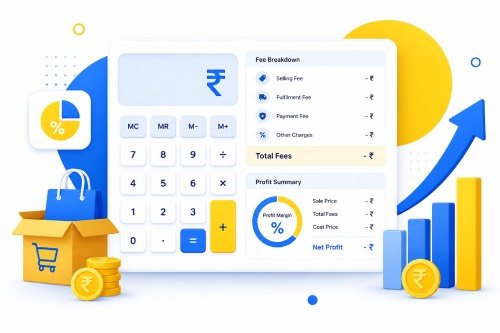
Instead of estimating your margin by hand, run your product’s price, category, and weight through the Flipkart Seller Fee Calculator. It applies the current commission, collection, shipping, and fixed fee structure to give you your actual expected payout — before you commit to a listing price.
This is especially useful before a big sale event, when you’re deciding how much discount room you actually have without cutting into your margin past the point of profitability.
How to Actually Improve Your Flipkart Margins
Once you know exactly what you’re paying in fees, a few levers make the biggest difference:
Price with the fee stack built in, not bolted on. Set your target margin after fees, not before. This changes how you think about discounting during sale events — you’ll know your real floor instead of guessing.
Reduce packaging weight where possible. Since shipping fees are weight-based, even small reductions in packaging can lower your per-order shipping cost across thousands of units.
Match fulfillment model to sell-through speed. Review your FBF vs self-ship split quarterly rather than setting it once and forgetting it.
Improve your ad spend efficiency. Fees determine your margin ceiling, but ad spend determines how much of that margin you keep. Tightening your campaigns so you’re not overpaying for traffic that doesn’t convert has a direct, compounding effect on profitability.
Optimize your catalog for conversion, not just visibility. A well-optimized listing converts more of the traffic you’re already paying fees and ad spend to acquire, which improves your effective margin without changing a single fee.
If ad spend and catalog optimization are the piece you’re less confident about, that’s exactly where a marketplace-focused team can move the needle — the fee structure is fixed, but how efficiently you convert traffic within it isn’t.
Know Your Numbers Before You List
Flipkart’s fee structure isn’t hidden, but it is easy to underestimate when you’re pricing dozens of SKUs across categories. The sellers who protect their margins are the ones who calculate the full fee stack before setting a price, not after reviewing a disappointing payout.
Run your numbers through the calculator, review your FBF vs self-ship mix, and revisit your fee assumptions every quarter. Small corrections here compound into real margin over a full selling season.
Want a full margin audit across your Flipkart catalog? Get in touch with our team for a free review of your current fee exposure and where you’re leaving money on the table.